calaveras

calaveras
papel picado
Showing posts with label Mackinac Island. Show all posts

Sunday, December 27, 2015

Looking Back and Looking Forward

2015 was filled with travel.  It was another one of those years where it seemed that now and then I was at home.  2016 is also shaping up to be busy year.

2015 began with a long trip to Mexico in January and February.  I flew to Oaxaca with my friend Jane and spent two marvelous weeks there.  That time in Oaxaca will always hold bittersweet memories for me, since Jane sadly passed away earlier this month.  It was our last travel adventure together.


After Jane returned to Ohio, I continued on to Mexico City to visit my friend Alejandro. I was hoping to avoid most of the Ohio winter, but even after my return, the bitterly cold winter seemed to stretch on endlessly.   I made another trip to Mexico City in April for Alejandro's birthday.


In July Alejandro came up here for a visit, and during his two weeks north of the border, we took an excursion to Mackinac Island in Michigan.  It is one of my favorite places in the United States, and I think that Alejandro thoroughly enjoyed our time there.

In September I went to Spain.  I traveled to three historic cities that I had never visited before... Burgos, León, and Valladolid, and I had a chance to see my cousin who lives in Madrid.


Just a little over a month ago I went to Mexico City again.  For the past four years I have been traveling there in November.  No matter how often I visit, I always find new places to explore.


The new year of 2016 is nearly upon us.  In eight days I will be returning to Mexico.  I will begin in one of my favorite cities in Mexico... Mérida, the capital of the state of Yucatán.


A friend, Frank, will be traveling with me, and I will be playing "tour guide" once again.  Over the years I have taken many friends to Mérida, and they have all fallen in love with the city.  This will be Frank's first trip to Mexico, and I am hoping that he too will find Mérida to be a delightful city.

From Mérida I will continue on my own to Mexico City.  Fellow blogger, Kim, the author of "El Gringo Suelto" will be south of the border at the same time, and we are looking forward to meeting up again. 

Alejandro will be returning with me to Ohio for a visit.  He will have a chance to experience winter in Ohio.  Hopefully the weather will not be as brutal as it has been for the past two years.  (A mild winter is predicted thanks to "El Niño".)  However it would be nice if we had a bit of snow... just enough to make the landscape look pretty.

In August of next year I will return to Switzerland.  Three of my Swiss cousins will be celebrating their 60th birthdays that month, and I have been invited to the big party.  It will be wonderful to see my Swiss family again, and to meet even more of my distant cousins.


As long as I am on that side of the ocean, I have been thinking about visiting some other European country that I have not yet seen.  But no plans have been made yet.

I hope that my readers have a wonderful new year!


Wednesday, July 29, 2015

Historic Mackinac Island

(This morning I took my friend Alejandro to the airport for his trip home to Mexico City.  However, I still have a number of posts to write about the places that we visited during his two week stay up here.)

Michigan's Mackinac Island is not only a picturesque summer resort, but it is a place filled with history.  On our second day on the island, Alejandro and I spent much of our time visiting its historic sites.

Archaeological finds have shown that the area was inhabited by Native Americans for at least 700 years before the arrival of the Europeans.  The island was sacred to the early tribes as the home of the Great Spirit.

In the 1600s French explorers, fur traders and missionaries were the first Europeans to arrive on the scene.  In 1670 a Jesuit mission was established on the island, but the following year Father Marquette moved the mission to nearby St. Ignace, on the Upper Peninsula at the northern side of the Strait of Mackinac.  By the early 1700s the French built Fort Michilimackinac on the opposite side of the strait.  The area became a center for the lucrative fur trade.

After the French and Indian War, France lost her North American territories, and the British took control of the region.  In 1780 the British built Fort Mackinac on the bluffs of the island.  It remains the most important historic landmark on Mackinac Island.


The views from the heights are superb and show what an excellent defensive position the fort occupied.


After the American Revolution, control of the fort passed to the United States.  However, at the beginning of the War of 1812, the British immediately invaded the island.  The small American garrison at the fort had no choice but to surrender to the superior British forces.
To consolidate their control over the island, the British also built another fort on the highest point of the island.  It was named Fort George in honor of King George III.  After the war, the Americans renamed it Fort Holmes after an American major who died during the Battle of Mackinac Island in 1814.  The original wooden fort no longer stands, but Mackinac State Park is currently building a replica of it.  It is close to completion but is not yet open to the public.


In 1815 the United States Army took control of the Fort Mackinac once again.  However as relations with British Canada improved, the fort's strategic importance declined.  Finally in 1895, the fort was decommissioned and transferred to the state of Michigan.  The 235 year old site is one of the most complete early forts in the United States, and today it is operated as an historic museum by the Mackinac Island State Park Commission.  Displays in the fort buildings portray life at the fort in the late 1800s.  
 
 
Soldiers' barracks
 
Commanding officer's house
 
Schoolhouse for officers' children
  

Friday, July 24, 2015

Bicycling Around Mackinac

From our base in St. Ignace on Michigan's Upper Peninsula, Alejandro and I spent two days exploring Mackinac Island.  This little island, about 4 square miles in size, is located in Lake Huron near the Strait of Mackinac.  It is probably the most historic place in the Midwestern United States (the entire island is listed as a National Historic Landmark), and since the late 1800s it has been a popular summer resort.  The island only has around 500 permanent residents, but in summer the population swells when hotels, shops and restaurants open to serve the influx of tourists.  Among the shops are numerous businesses which make the island's famous fudge.  Few tourists, I suspect, leave the island without buying some fudge, and visitors to the island are referred to as "fudgies".

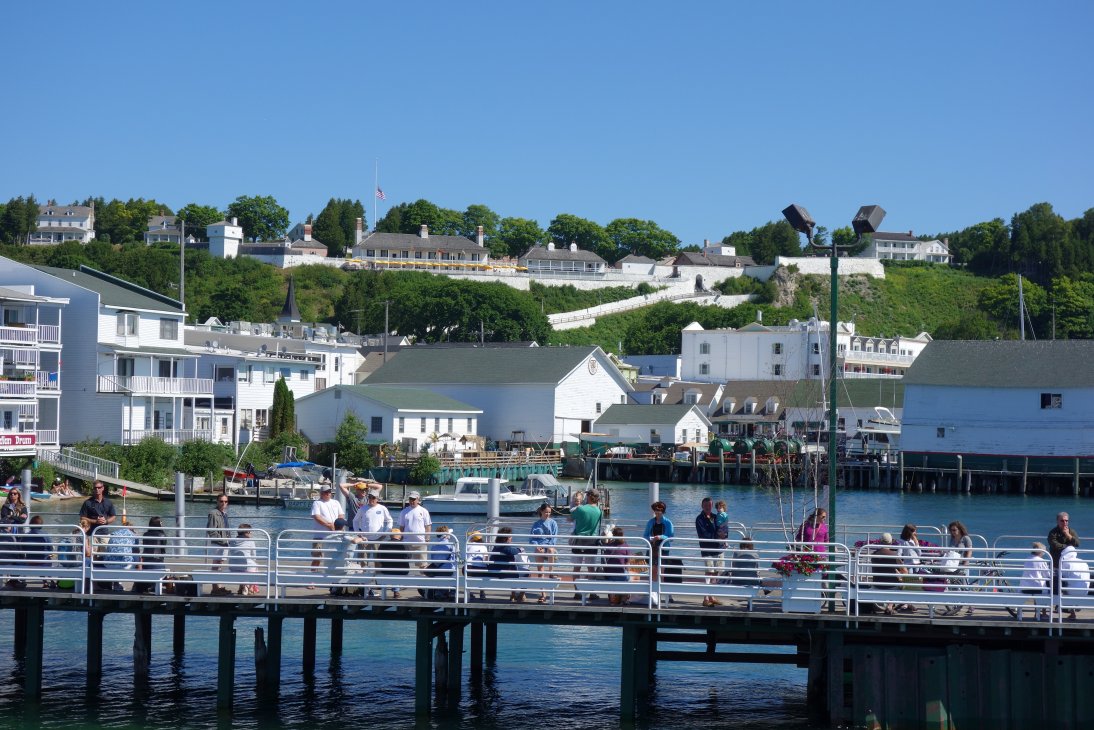
We reached the island via one of the ferry boats that leave frequently from St. Ignace.  (There is also ferry service from Mackinaw City on the Lower Peninsula.)  The boat brings you to the busy harbor of the town.


Main Street in the town.
 
 
The island's unique atmosphere is enhanced by the fact that there are no cars allowed.  The only motorized vehicles are emergency and service vehicles.  All transportation is by foot, horse drawn carriage or bicycle.  Shortly after we arrived, Alejandro and I rented bicycles to tour the island.
 
 
As we headed out of the town, we passed St. Anne's Catholic Church.  Although the building dates from the 19th century, it traces its history back to the French mission established by the Jesuits in the 1600s.


The island is circled by an 8 mile road... the only state highway in the United States which does not have any automobile traffic.  The beaches of the island are rocky.   In the past few years it has become a custom for tourists to pile the stones on top of each other.  All along the shore you see these stacks of stones... some of them are rather tall and elaborate.


We parked our bikes to climb this flight of over 200 steps...
 
 
Looking down from the staircase at the crystalline waters of Lake Huron...
 
 
The staircase leads to an observation deck with a view of the island's most interesting geological formation, Arch Rock.
 
 
The beach known as British Landing is the spot where British troops invaded the island during the War of 1812.
 
 
Upon returning to town, we made a detour to visit one of the island's most famous landmarks, the Grand Hotel.  The hotel was opened in 1887, and Thomas Edison, Mark Twain, and five U.S. Presidents were guests here.  There is a $10 charge for non-guests to visit the grounds and public areas of the hotel.  It's a bit of a rip-off, but better than paying $300 per night to stay there.


The hotel boasts the longest porch in the world.
 
 
The 1980 film "Somewhere in Time", a cult classic starring Jane Seymour and Christopher Reeve was filmed at the Grand Hotel.
 
 
Just beyond the hotel on the West Bluff of the island is a street lined with Victorian era summer "cottages".  Most of these "cottages" are spectacular mansions... and their flower gardens are just as spectacular.