calaveras

calaveras
papel picado
Showing posts with label Peru. Show all posts

Tuesday, November 10, 2020

Cultures of the Andes

Continuing with our visit to the Cleveland Museum of Art...

After my cousin Gail and I visited the gallery of pre-Hispanic art from Mesoamerica (Mexico and Central America) we moved into the adjacent room which is filled with archaeological treasures from South America, specifically the cultures that flourished in the Andes of Peru before the arrival of the Spanish.

The Incas are the best known of those civilizations, but there were many other cultures which preceded them.  In fact the bulk of the objects in the museum's collection are from those earlier groups.

The Paracas culture flourished along Peru's coast from 800 B.C. tp 100 B.C.  It is best known for its superb textiles which, due to the arid conditions, have amazingly survived the centuries.  Most of these fabrics were found in graves.


The Nazca civilization is best known for its mysterious lines along the Peruvian coast, but it also produced an abundance of pottery.


The Mochicas lived in northern Peru between A.D. 100 and 700.  Their pottery features the most realistic human portraits of any culture in the Andes.  The jars often had distinctive stirrup shaped spouts.


Some of the Mochica vessels portray animals, such as the sea lion pup and the feline below.


This one has a deer's head with a human body and is performing the coca leaf chewing ritual.


These gold beakers are from the Sisán culture (750-1100).


Sisán was conquered by the Chimu Empire (900-1470).  This rare piece of wood carving was the backrest of a litter which was carried by porters to transport a noble.


The Wari Empire flourished between 600 and 1100.  Here you see several examples of Wari pottery.

A double spouted vessel


It is not known if this image is of a god, an ancestral mummy or of a high-ranking noble.  His hands are cupped around holes would have originally held staffs of authority.


A vessel with porters carrying a dignitary in a litter.  The spout extends through the nobleman's body.


There is much more from the Cleveland Museum of Art coming in future posts.

Monday, September 19, 2016

The Crazy Spanish Teacher

As I was sorting through my pictures on my new computer, I ran across this old photo of me from back in my teaching days.  I don't think that I have ever posted it on the blog before.  (If I have, excuse the repetition.)


A number of times on my travels, I purchased traditional attire from the countries that I visited.  I had a complete "gaucho" outfit from Argentina, Mayan clothing from San Cristobal de las Casa in Chiapas, Mexico, and this native Andean outfit from my trip to Peru.  When we studied one of those countries in my advanced Spanish classes, I would get dressed up in the appropriate attire. 

My Peruvian duds included a pair of scratchy wool pants and shirt, an alpaca poncho, and two traditional hats, one worn on top of the other.  I even had an Andean panpipe.  In between classes I would stand in the hall by my door.  I don't know how to play the panpipe, but I would be tooting away on it.  The passing students would look at me in disbelief.  My students would come into class chuckling and probably thinking, "Crazy 'señor' is at it again!"

Those were the days, back when teaching was actually fun!

Friday, October 30, 2015

Seven Archaeological Wonders

Since ancient times people have been making lists.  Ancient Greek writers compiled a list of wonders of their known world... seven of them because they considered the number seven to represent perfection.

I have always been fascinated by vanished civilizations, so I thought I would make a list of my seven favorite archaeological sites.  Just as the Greeks did not have knowledge of the entire world, I have not traveled to many astounding places. I have not seen the Coliseum of Rome, the Parthenon of Athens, or the Great Pyramids of Egypt, just to name a few.  Obviously, since I have traveled so many times to Mexico, sites in that country are overrepresented. 

There are also some places I have visited which many travelers would probably put on their list, but which I have not included.  It is certainly amazing how the ancient inhabitants of Britain transported huge stones to create Stonehenge.  Yet that site did not "wow" me.  (The fact that visitors are no longer allowed to get close to the ruins did not help.)  The Mayan city of Chichén Itzá made it to the new list of wonders announced in 2007.  As impressive as it is, the hordes of day-trippers who flock there from Cancun and the army of annoying souvenir vendors have spoiled it for me.

So here is my very subjective list...   

7.  The Roman Aqueduct in Segovia, Spain


Every time I visit Segovia I catch my breath when I first glimpse this aqueduct built by the Romans 2000 years ago. It is nearly 100 feet high, and was built entirely without mortar.  The fact that it has survived the centuries and continued to provide water to the city until the 19th century is amazing.


6.  The Mayan Ruins of Uxmal, Mexico


With its pyramids, palaces, and intricately designed stone mosaic decorations, Uxmal is one of the most impressive Mayan cities.  When I take friends to the Yucatán, I take them here rather than to Chichén Itzá.   No crowds, no vendors, and you can still climb most of the ruins.


5.  Teotihuacán, Mexico


More than fifteen hundred years ago, Teotihuacán was one of the largest cities in the entire world.  And then it was mysteriously abandoned.  It's sheer size is astounding.  The Pyramid of the Sun is the third largest pyramid in the world.  Although it receives large numbers of visitors (it's located about 30 miles from Mexico City), the site's vastness easily absorbs the crowds.  The two pyramids can be climbed, offering impressive views.


4.  Palenque, Mexico


Located in the tropical rainforest of the Mexican state of Chiapas, Palenque is one of the most beautiful examples of classic Mayan art and architecture.  Although you are no longer permitted to climb the Pyramid of the Inscriptions and descend into the burial chamber of King Pakal, it remains a stunning and evocative site.


3.  Cantona, Mexico


Not many people have heard of this impressive site which is located about three hours from Mexico City near the border of the states of Puebla and Veracruz.  More than 1000 years ago it was a major city along the trade route from the Gulf coast to the Mexican highlands.  It is the largest archaeological site in Mexico.  The beautiful scenery all around you, and the fact that you have the place almost to yourself, make this one of my favorites.


2.  Monte Albán, Mexico


Two thousand years ago the Zapotec tribe leveled the top of a mountain to construct their huge ceremonial center.  It is an amazing construction feat. All around you are marvelous views of the mountains and valleys of Oaxaca.


1. Machu Picchu, Peru


There is absolutely no doubt that my favorite archaeological site is the Incan ruins of Machu Picchu in the Andes Mountains of Peru.  It was constructed 1000 feet above the valley floor on a saddle between two mountain peaks.  The astonishing Incan stonework combined with the spectacular mountain scenery combine to make this the most incredible place that I have ever visited!

Friday, June 26, 2015

Journey to the Amazon

In the last two posts I wrote about my visit in 1985 to the Incan ruins of Machu Picchu in Peru.  My Peruvian adventure, however, began with two nights in the Amazon rainforest.  Although the Amazon River is most associated with Brazil, it is born from the melting snows of the Andes from where it flows 4000 miles eastward, crossing nearly the entire breadth of the South American continent, to the Atlantic.  Half of Peru, everything east of the Andes, is in the Amazon Basin.

After flying to the capital city of Lima, I continued on a flight to Iquitos, the major city in the Peruvian Amazon.  Ocean-going ships can travel over 2000 miles up the Amazon to Iquitos.  The city is accessible only by boat or plane.  It is the largest city in the world inaccessible by road.

My flight was on the now defunct domestic carrier, Faucett Airlines.  (It was the only airline in the world with in-flight bingo games!  Bingo is very popular in Peru.)


I was met at Iquitos Airport and driven to the riverfront where I boarded a small boat to take me to my hotel.


This picture, taken from the boat, gives you an idea of how mighty the Amazon is.  The boat was in the middle of the river, so you can see that even at this point, far upstream, the river is very wide.


Although the Amazon is not the longest river in the world (that record is held by the Nile), it is by far the largest in terms of the flow of water.

Leaving Iquitos far behind, we eventually turned onto a small tributary, and arrived at my hotel, the Amazon Jungle Lodge.  The hotel consists of several buildings with thatched roofs.  The buildings and the walkways connecting them are all built on stilts because during the high water season the river overflows its banks.


This was my room.  As you can see, the accommodations were far from luxurious.  The ceiling of the room is a screen to keep out anything that might otherwise enter through the thatched roof.


Here I am with one of the hotel's residents, a little green parrot named Marú.  Marú was quite talkative.  He (she?) liked to say "Viva el Peru" (Long live Peru), and "Corre, corre, caballito" (Run, run, little horse).


After settling into my room, I was taken upstream to a small indigenous village to see native life on the river.  I am sure that the whole thing was staged.  I can imagine the villagers saying, "Tourists are coming.  It's time to take off our tee-shirts and jeans, and put on our grass skirts."
 
 
The village elder is posing here with a blowgun that I purchased.  They had a variety of handicrafts for sale.  However since they do not exist in a money economy, tourists must barter with them.  The tour information that I received before the trip said that I should bring some small household items... like needles and thread... to trade for their handicrafts.

I lugged around that blowgun for the rest of my trip through Peru and Ecuador.  I had no problems until I returned to the U.S.  I was not allowed to carry it with me onto the plane for the last leg of my flight home.  They put it in a box and checked it with my luggage.  The ironic part is that it wasn't until I returned home that I discovered that it was not a functional blowgun.  It wasn't hollow all the way through!

The elder gave a demonstration with a large, genuine blowgun.


I was given a chance to try my luck.  Needless to say, I was unable to shoot the dart anywhere near the target.


One of the most incredible experiences in the Amazon was one for which I have no photos.  We went out on a boat the first evening to look at the night sky.  I have never seen so many stars in my life!  We are so used to our "light pollution" that what I saw seemed unreal... but that was what the sky truly looks like.

The next day we were taken out on a small boat to go fishing.  I'm ashamed to admit it, but prior to this I had never been fishing.  What did I catch?  A piranha!  Of course, I let the boatman remove it from the hook.


Later that afternoon, one of the hotel guides took me for a hike through the forest.  The guide was a young fellow named Clever. (Yes, that was his name.  He said to me, "That means 'smart' in English.")


We did not see any snakes or jaguars on our hike.  Most animals have retreated deeper into the rainforest.  There were a lot of insects however.  Clever was constantly swatting away mosquitos.  I however was slathered in repellent, and I never had a bite the entire time I was there.  (The expensive malaria pills which the doctor prescribed before the trip, turned out to be unnecessary.)

Although I didn't see any wildlife, the vegetation was amazing.  Here I am standing in front of a huge tree.  That entire background is the trunk.


After two days in the rainforest, a boat took me back to Iquitos, and I took a plane back to Lima.


Even though I was "roughing it", the Amazon excursion was thoroughly enjoyable.  In fact, I don't think I have ever been so relaxed.in my life.  It seemed as if the worries of the world were a thousand miles away.

Wednesday, June 24, 2015

Another Day at Machu Picchu

In my previous post I wrote about my visit to the Incan ruins of Machu Picchu in 1985.  As I mentioned, I spent the night at what was back then the only hotel there.  Since the return train did not leave until late afternoon, I had most of another day to explore this incredible place.

On my second day, I got up early, hoping to view the sunrise.  Unfortunately. the morning was overcast.  I was at first disappointed, but the Incan city, shrouded in mist, had a mysterious, even eerie, atmosphere.  I had the site practically to myself, and I imagined that at any moment the ghosts of the departed inhabitants might materialize out of the fog. 


I climbed to the "Inti Watani", the hitching post of the sun, where centuries ago Incan priests performed ceremonies to ensure the continued existence of the sun. 


As I lingered there, the fog and clouds, like billows of smoke, began is dissipate, and sunlight bathed the rugged mountains.  Far in the distance I could discern snow-capped Andean peaks to the west.  It was a truly magical moment.


I returned to the hotel for breakfast.  There I chatted with another traveler, a lady who was a schoolteacher from Pennsylvania.  We decided that we would hike a short distance along the Inca Trail, the road which connected Machu Picchu with the Incan capital of Cuzco, fifty miles away.

We passed through the old gate and headed out of the city.


We walked uphill, perhaps a couple miles, along the trail...


until we came to the remains of an Incan structure.  This was the spot we were looking for... a panoramic, "travel poster" view of Machu Picchu.


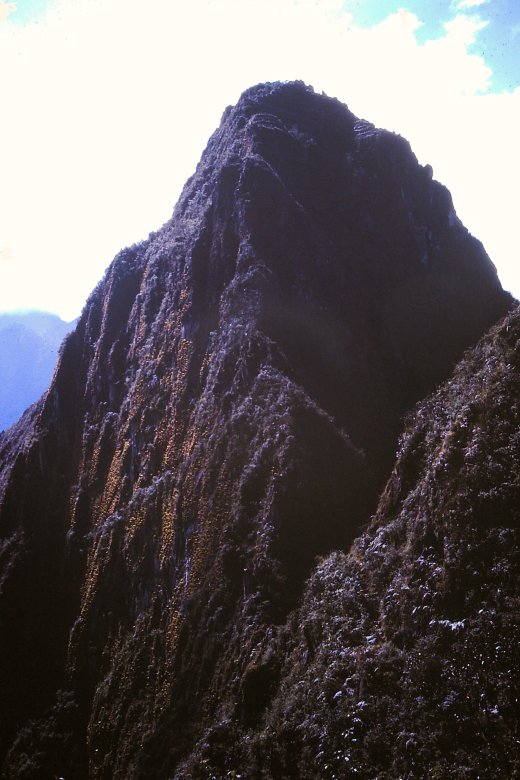
After returning to the ruins, we still had several hours before our scheduled departure.  So we decided to be intrepid adventurers, and climb the path leading to the top of Huayna Picchu, the rugged mountain peak which towers 1000 feet above the site.
 
 
It was a strenuous climb along the slippery path... and descending was downright scary.  After climbing for what seemed an eternity, we came to an Incan wall.  There was a rope with which we had to hoist ourselves to the top of the wall where the path continued.  On and on we climbed.  Finally we entered a tunnel. At the end was a rickety ladder.  We climbed the ladder, and there we were... on the boulder strewn summit of Huayna Picchu!
 
 
"Hurry up, and take the picture" I'm thinking as I sit precariously close to the edge.
 
 
The view from the top is spectacular.  Spread below us, as if in miniature, are the ruins, the agricultural terraces, the hotel, the twisting road to the site, and the Inca Trail.


As I said at the beginning of my previous post, this trip was the most unforgettable of my life, and my two days at Machu Picchu were probably the greatest adventure I have ever experienced!


Monday, June 22, 2015

The Trip of a Lifetime

I have visited many wonderful places in my life, but without a doubt the most incredible trip that I have ever taken was one that I did way back in the summer of 1985.  I splurged and took a three week tour of Peru and Ecuador.  Generally I avoid guided tours.  I do not like being herded around like cattle with a group of tourists.  But on this trip I had private guides at each place on the itinerary, and I also had plenty of free time to explore on my own.

Of course, the place that I was most interested in seeing was Machu Picchu, the so-called "lost city of the Incas".   This remote Incan town was built around 1450 on a saddle between two mountains more than 1000 feet above the Urubamba River.  It was not a large city, but from its splendid architecture, it must have been a place of importance.  Archaeologists suggest that it might have been a retreat for the Incan emperor and his court.  Because of its location, the Spanish "conquistadores" never knew about the place, and it wasn't until 1911 that an American professor, Hiram Bingham, found it, and brought it to the attention of the world.  (It really wasn't a "lost city" however, since the locals knew about it all along.)

Back when I went there, Machu Picchu was much less developed for tourism.  Even today, visitors must take a train to get there (or hike for several days along the famous Inca Trail). Upon arriving at the train station in the valley below the ruins, they are transported in little buses up the twisting road to the archaeological site.  Back then there was only one small, government-run hotel at the site, so the majority of tourists took the morning train, spent a few hours at the ruins, and then caught the train back in the late afternoon.  Today there are numerous hotels, B&Bs and restaurants in the village that has grown up in the valley.  The number of visitors has grown enormously... it is the number one tourist destination in all of South America... and the sheer numbers pose a threat to the preservation of the site.

On the tour that I took, I was fortunate to have overnight accommodation at that one little hotel, so I had plenty of time to thoroughly explore this fantastic place in relative solitude.


This is the hotel where I stayed.  It was only a few feet from the entrance to the archaeological site.  The place was simple, but clean, comfortable and modern (although the generator for electricity was turned off after a certain hour at night).  Notice the buses which transported visitors up from the train station. From what I have read, the hotel has been replaced by a luxury hotel which charges $1000 per night!


  As you enter the archaeological site, you first pass through the "agricultural section".  These reconstructed buildings would have been the homes of the farmers.


Next to those houses are magnificent terraces, climbing the mountainside, where the crops to feed the population were cultivated.


From there, you enter the "urban section" of the site.  The distinctive mountain peak rising above the ruins is called Huayna Picchu (The Young Mountain).


One half of the "urban section" appears to have been reserved for nobility.  Archaeologists assume this because of the fine quality of the stonework of these constructions.


In this royal neighborhood is a structure which is thought to be the Temple of the Sun.  It has a curved wall similar to the Temple of the Sun in Cuzco, the Incan capital.  The stonework is of amazing quality.  The Incas had no iron tools to cut the stone, but the builders were able to fit the blocks together perfectly without mortar.


For obvious reasons this building is called the Temple of the Three Windows.  It may commemorate the myth that told that the founders of the Incan tribe emerged from three windows in the mountains.


At the highest point of the royal neighborhood is this carving cut out of the sheer rock.  It is called the "Inti Watani"... "The Hitching Post of the Sun".  At the winter solstice, when the sun was lower in the sky, the priests performed a rite which supposedly tethered the sun lest it disappear.  Of course after that ceremony, the sun would gradually start to rise higher in the sky.  Very few of these "hitching posts" survive.  The Spanish destroyed most of them because they were a part the pagan religion of the Incas.

Some more photos of this fantastic place...


 (In the background you can see the winding road which climbs up to Machu Picchu.)


I spent several hours wandering around the ruins, but late in the afternoon it began to rain.  I went back to the hotel and took a short nap.  When I woke up, the rain had stopped, the sun was out, and this was the view from outside the hotel...


I will write about my second day at Machu Picchu... which was equally amazing... in my next post.