Yesterday I flew home to Ohio. Everything went quite smoothly. My flight from London Heathrow Airport left from the new Terminal 2. I was impressed with the terminal. I'm not sure if I was just lucky, but I did not have to stand in any long lines at all. Even passing through security went quckly. I had been reading that security was being beefed up for flights leaving for the U.S., that travelers would randomly have their electronic devices checked. But I went through with a minimum of fuss, and had plenty of time to eat a leisurely breakfast before it was time to board the plane.
The long flight from London to Newark seemed to go by quickly. I watched two movies. The first was "Saving Mr. Banks", which told of the wrangling between Walt Disney and the British author P.L. Travers over the film adaptation of her "Mary Poppins" books. Although it was not historically accurate, it was a very enjoyable movie. The second film I watched was "Mary Poppins". Can you believe that I had never seen that movie before?!
Before I knew it, were preparing for landing at Newark. Things went smoothly there too, except for a half hour delay in my flight to Cleveland.
I arrived home at around 6:30 P.M. (11:30 P.M. London time), and very tired. Nevertheless, I forced myself to stay up for a while to force myself back into the Cleveland timeframe. Today I feel just a bit jet-lagged.
It was a great trip, but it's good to be home.
CDMX

Tuesday, July 8, 2014

Sunday, July 6, 2014
Farewell to England
Today was my last full day in England. I went with Kevin, Sue, and their sons Charlie and Scott to Witham, a town in the county of Essex about 50 minutes to the northeast of London. We had lunch at the restaurant of a golf club there, and we were joined by Kevin's parents, Dave and Pat, and his sister Ed (Edna) who live in the area. So I had the pleasure of meeting yet two more cousins... Kevin's sister and I are third cousins, and I am his dad's second cousin once removed. It was a lovely afternoon.

To the back, Kevin, Scott, Charlie, and Kevin's dad and mom
In front Sue and Kevin's sister Ed (Edna)
Tomorrow, after a very lengthy trip, I return home to Ohio. Kevin will come to the hotel tomorrow morning and take me to Heathrow Airport for my flight. I am so grateful to Kevin and Sue for all the hospitality and kindness which they showed me during my stay in England. I look forward to welcoming them again in Ohio in the future.
It has been a wonderful trip. On the one hand, the time has flown by. On the other hand it seems as if I have been away from home forever. The beginning of my journey in Spain now seems like a distant memory.
Other than the snafu with the train from Barcelona to Paris and a couple days where I did too much and tired myself out, the entire trip was absolutely splendid. It was filled with so many great experiences... showing my sister-in-law Phyllis familiar places in Spain, discovering new places, and spending time with my cousin Werner in Madrid, and my cousin Kevin and his family in England... and even meeting new cousins.
Now the time has come to return home. I hope that my readers have enjoyed sharing my experiences in Europe!
Saturday, July 5, 2014
A Day at the Races
The British Isles have a long tradition of horseracing, so when my cousin Kevin suggested that we go to a racetrack, it sounded like fun, especially since I had never been to a horse race before.
This afternoon Kevin, Sue, their younger son Scott, and I went to Sandown Park which is located in the suburb of Esher to the southwest of London. Today they were holding one of the most important races of the year, the Eclipse Stakes.


There were seven races run today, and we placed a two pound minimum bet on each race. Scott is too young to bet, so he and his mom chose a horse together, and Kevin and I each chose a different horse. We figured that between the three horses there would be a fair chance that one of us would win.
Sue and Scott won the first race.

I won the second race. I had placed a bet on a horse named Extortionist, and my two pound bet earned me over 16 pounds.


We then went through several races without winning anything, including the big race, the Eclipse Stakes. However, in the sixth race, Kevin picked the winner.

So we were all winners, and at the end of the day came out about even. It was a fun day!
This afternoon Kevin, Sue, their younger son Scott, and I went to Sandown Park which is located in the suburb of Esher to the southwest of London. Today they were holding one of the most important races of the year, the Eclipse Stakes.
There were seven races run today, and we placed a two pound minimum bet on each race. Scott is too young to bet, so he and his mom chose a horse together, and Kevin and I each chose a different horse. We figured that between the three horses there would be a fair chance that one of us would win.
Sue and Scott won the first race.
I won the second race. I had placed a bet on a horse named Extortionist, and my two pound bet earned me over 16 pounds.
We then went through several races without winning anything, including the big race, the Eclipse Stakes. However, in the sixth race, Kevin picked the winner.
So we were all winners, and at the end of the day came out about even. It was a fun day!
Friday, July 4, 2014
High Tea
This afternoon Kevin, Sue and I took the train to central London. We walked across the Thames River on the Jubilee Bridge, a footbridge which was built in 2002 to commemorate the 50th anniversary of Queen Elizabeth's accession to the throne.


Kevin and me on the Jubilee Bridge
We went to County Hall, a large building which used to be the headquarters of the London County Council, but which is today occupied in part by a Marriot Hotel. There we had a very elegant high tea. We were seated next to a window overlooking the Thames and Big Ben. We were served champagne and presented with a wide selection of teas to chose from. A three tiered tray was placed on the table. The lower tier was a plate of finger sandwiches, including smoked salmon, cucumber, and beef with horseradish. The second tier contained scones, both savory and sweet. The sweet scones served with clotted cream and strawberry jam were delicious. The top tier was a selection of little cakes. I had never thought of tea as a filling meal, but by the time we were finished we were all quite full. It was a delightful and thoroughly British experience, and I was so thankful that Kevin and Sue had brought me there.
Kevin and Sue on Westminster Bridge after our lovely afternoon tea.
Thursday, July 3, 2014
Ancestral villages
This morning my cousin Kevin picked me up early in the morning to escape the London area before the rush hour traffic was too heavy. We drove a couple hours to West Berkshire to visit the towns and villages which our ancestors knew. The weather was warm and sunny, a perfect day for our trip into the bucolic countryside.
Our first stop was the largest of the four towns we visited... Hungerford, with a population of around 6,000 people. It is crossed by the Kennet and Avon Canal.

None of our ancestors actually lived in Hungerford, but it was the location of the regional poor house, the Hungerford Union. My great grandmother, and our great-great-great grandfather had the misfortune of spending some time in the Hungerford Union. Today, all that remains of the poor house is the chapel.

Our first stop was the largest of the four towns we visited... Hungerford, with a population of around 6,000 people. It is crossed by the Kennet and Avon Canal.
None of our ancestors actually lived in Hungerford, but it was the location of the regional poor house, the Hungerford Union. My great grandmother, and our great-great-great grandfather had the misfortune of spending some time in the Hungerford Union. Today, all that remains of the poor house is the chapel.
My ancestors probably traveled this street as they were taken to the poor house.
The nearby town of Lambourn, population 4000, is noted as a center for horse stables and horse racing. The small town is dominated by its church, St. Michael and All Angels. There is mention of the church in records from the tenth century, but the oldest parts of the present church date back to Norman times in the late twelfth century. The rest of the structure dates from the fourteenth and fifteenth century. Most of the stain glass windows are from the Victorian era. For such a small town, Lambourn has a remarkably beautiful church.

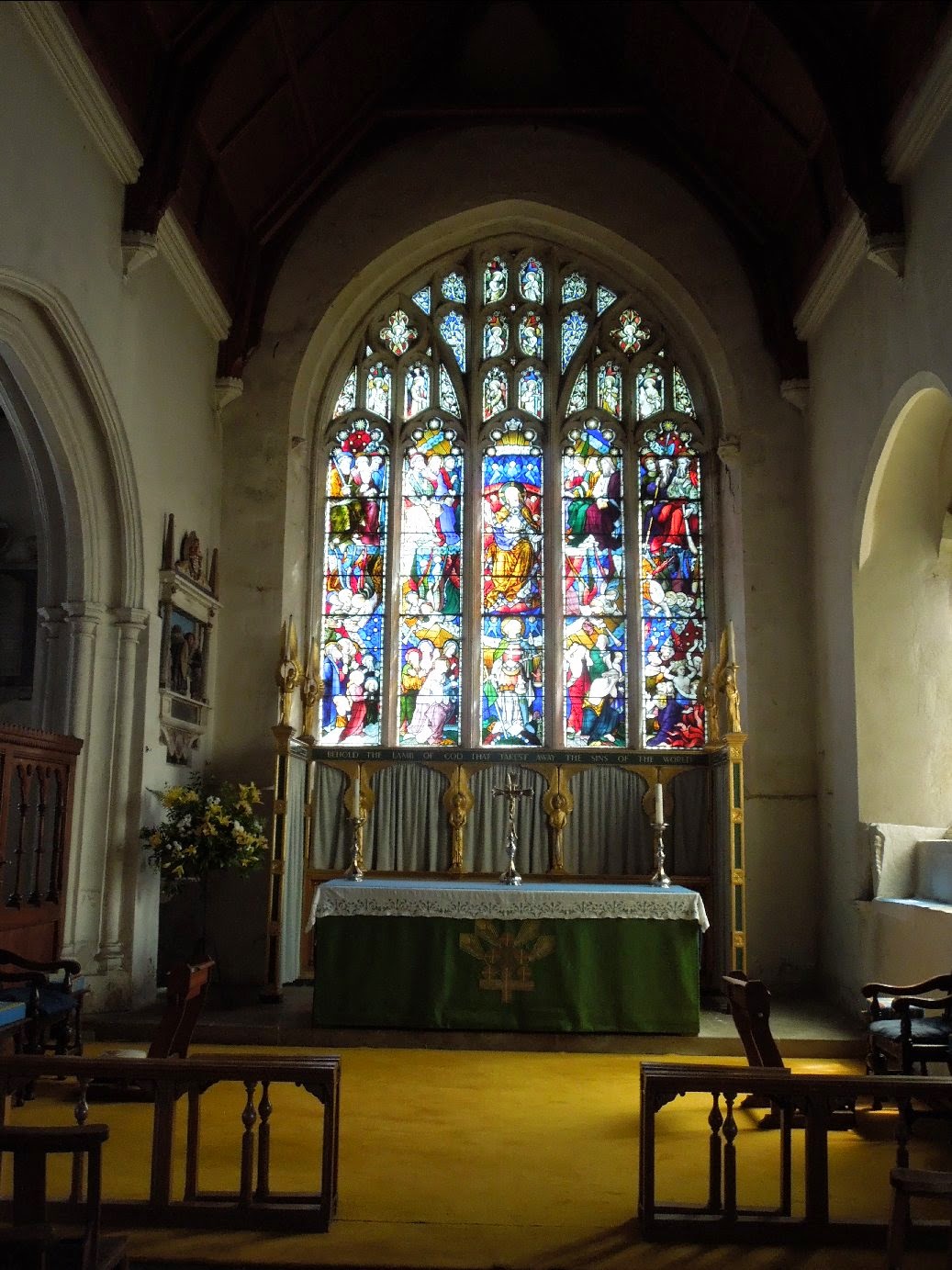
Although our ancestors did not live in Lambourn, many of the family members were baptized in this church.
One and a half miles down the road from Lambourn is the tiny village of Eastbury. This was where Kevin's great grandfather and my great grandmother (brother and sister) were born. Kevin believes that this little row house was their home.

Today it has a pretty garden, a satellite dish and new windows. But imagine that in the 1800s there were at one point eleven people living in this house... our great-great-great grandparents, our great-great grandparents and their seven children.
Running through the village is the Lambourn River which is hardly more than a creek. However the river is prone to overflowing its banks, and in the heavy rains that plagued much of England this past winter, there was flooding.

There are still many houses with thatched roofs.

This house was in the process of having its roof re-thatched by a company that advertises itself as "Master Thatchers".

Eastbury did not even have its own church until the late 1800s, hence the reason why my great grandmother, Kevin's great grandfather, and their siblings were baptized in Lambourn.
However, our great-great grandfather is buried here in an unmarked grave. Poor families such as our ancestors could not afford a gravestone.

We stopped for lunch in Eastbury's pub, The Plough. I had eaten there when I visited the village in 2009. The same waitress was working there, and she remembered me. On my previous visit I had told her about my genealogy research. Her family has lived in the area for generations. Her ancestors and mine were apparently good friends, because her great-great grandfather's name appears as a witness on the marriage document of my great grandparents. It's a small world, but not entirely unexpected given the small populations of these villages.

From Eastbury it is only one mile to the village of East Garston, the home of more of my ancestors. Portions of East Garston's church date back to Norman times. In was here that my great grandparents, John and Fannie Paintin were married. (Fannie would have been Kevin's great-great aunt.)


My ancestral villages today seem quite idyllic. But I have to wonder what they would have looked like 150 years ago, when the roads were probably of dirt, and sanitation was probably poor.
***My apologies if all of this genealogy stuff is confusing. Believe me, at times it makes my head spin, trying to keep track of all my ancestors!***
Although our ancestors did not live in Lambourn, many of the family members were baptized in this church.
One and a half miles down the road from Lambourn is the tiny village of Eastbury. This was where Kevin's great grandfather and my great grandmother (brother and sister) were born. Kevin believes that this little row house was their home.
Today it has a pretty garden, a satellite dish and new windows. But imagine that in the 1800s there were at one point eleven people living in this house... our great-great-great grandparents, our great-great grandparents and their seven children.
Running through the village is the Lambourn River which is hardly more than a creek. However the river is prone to overflowing its banks, and in the heavy rains that plagued much of England this past winter, there was flooding.
There are still many houses with thatched roofs.
This house was in the process of having its roof re-thatched by a company that advertises itself as "Master Thatchers".
Eastbury did not even have its own church until the late 1800s, hence the reason why my great grandmother, Kevin's great grandfather, and their siblings were baptized in Lambourn.
However, our great-great grandfather is buried here in an unmarked grave. Poor families such as our ancestors could not afford a gravestone.
We stopped for lunch in Eastbury's pub, The Plough. I had eaten there when I visited the village in 2009. The same waitress was working there, and she remembered me. On my previous visit I had told her about my genealogy research. Her family has lived in the area for generations. Her ancestors and mine were apparently good friends, because her great-great grandfather's name appears as a witness on the marriage document of my great grandparents. It's a small world, but not entirely unexpected given the small populations of these villages.
From Eastbury it is only one mile to the village of East Garston, the home of more of my ancestors. Portions of East Garston's church date back to Norman times. In was here that my great grandparents, John and Fannie Paintin were married. (Fannie would have been Kevin's great-great aunt.)
Our ancestors were agricultural laborers. A few generations earlier they would have probably been called peasants... and maybe generations before that, serfs. As I said, they could not have afforded gravestones. However, John Paintin's father, William, served as the parish clerk. So the church provided a marker for him and his wife Miriam. The weathered inscription is difficult to read, but still legible. Here I am by the grave of my great-great grandparents.
***My apologies if all of this genealogy stuff is confusing. Believe me, at times it makes my head spin, trying to keep track of all my ancestors!***
Wednesday, July 2, 2014
Hampton Court
Today I took the train to the southwestern outskirts of London to visit Hampton Court Palace.


Construction of Hampton Court began in 1514 when the property was purchased by Cardinal Wolsey, the favorite of King Henry VIII. The Cardinal built a lavish, luxurious palace, and the King was a frequent guest here.
Wolsey lost favor with the King because he could not secure from the Pope a divorce for Henry. The Cardinal hoped to return to the monarch's good graces by giving him the palace as a gift. Henry readily accepted the gift (although Wolsey remained out of favor), and Henry enlarged the palace in 1529.
Today, visitors may view several rooms that date to Henry's era, most notably the Great Hall, where state banquets were held.


Numerous people wander the palace in period costume, including "King Henry" himself.

Hampton Court continued to be used as a royal residence throughout the Tudor era, but later kings found the palace to be too old fashioned. The monarchs William and Mary planned to tear down the palace piecemeal while they built a new one which would rival Versailles. Mary commissioned the renowned architect Christopher Wren to draw up plans for the baroque palace. A portion of the Tudor structure was demolished and a new addition was built at the rear. However after Mary died, King William lost interest in the project, and the rest of the Tudor palace was saved. The baroque addition stands in contrast to the original Tudor design.

This lavishly painted stairwell in the apartments of King William is reminiscent of the Painted Hall in Greenwich (see previous post).

The last monarchs to reside in Hampton Court were George I and George II. Visitors may visit a number of rooms furnished in the style of that era.

During the reign of Queen Victoria, Hampton Court was opened to the public.
A visit would not be complete without a walk through the extensive gardens of the palace. The gardens of Henry VIII's era were replaced by landscaping in the grand style of the late 1600s.


Wolsey lost favor with the King because he could not secure from the Pope a divorce for Henry. The Cardinal hoped to return to the monarch's good graces by giving him the palace as a gift. Henry readily accepted the gift (although Wolsey remained out of favor), and Henry enlarged the palace in 1529.
Today, visitors may view several rooms that date to Henry's era, most notably the Great Hall, where state banquets were held.
Numerous people wander the palace in period costume, including "King Henry" himself.
Hampton Court continued to be used as a royal residence throughout the Tudor era, but later kings found the palace to be too old fashioned. The monarchs William and Mary planned to tear down the palace piecemeal while they built a new one which would rival Versailles. Mary commissioned the renowned architect Christopher Wren to draw up plans for the baroque palace. A portion of the Tudor structure was demolished and a new addition was built at the rear. However after Mary died, King William lost interest in the project, and the rest of the Tudor palace was saved. The baroque addition stands in contrast to the original Tudor design.
This lavishly painted stairwell in the apartments of King William is reminiscent of the Painted Hall in Greenwich (see previous post).
The last monarchs to reside in Hampton Court were George I and George II. Visitors may visit a number of rooms furnished in the style of that era.
During the reign of Queen Victoria, Hampton Court was opened to the public.
A visit would not be complete without a walk through the extensive gardens of the palace. The gardens of Henry VIII's era were replaced by landscaping in the grand style of the late 1600s.
Tuesday, July 1, 2014
Straddling the Hemishperes
This morning I took the train to Blackfriar's Station on the Thames River and then boarded the "river bus", a boat service which provides transportation up and down the river. From the boat I had excellent views of many London landmarks.

Pictured above is the HMS Belfast, a British cruiser which was active in World War II. It is now a museum ship permanently docked along the Thames. In the background is the skyscraper commonly referred to as The Shard. It was built in 2012, is 72 stories tall, and is the tallest building in the European Union.


Tower Bridge is the best known bridge in London. It was built in the late 1800s. Many people mistakenly think that it is the London Bridge of the nursery rhyme.

Farther down the river are the skyscrapers of Canary Wharf which has become one of the major financial districts of London.
My destination was the end of the line on the "river bus"... Greenwich.

When you get off the boat, the first thing that you see is the famous nineteenth century clipper ship, "Cutty Sark". The ship is in permanent dry dock at Greenwich, and is open to the public.


 The Hospital for Seaman became the Royal Naval College in 1873. Today the buildings are occupied by the University of Greenwich and the Trinity Conservatory. Two parts of the complex are open to the public... the Chapel of St. Peter and St. Paul and the Painted Room.


The Painted Room was designed as the dining hall of the hospital. The walls and ceiling are lavishly decorated with paintings which glorify England's naval power and the triumph of Protestantism under the monarchs William and Mary and Queen Anne. The naval hero Admiral Nelson lay in state here after his death in the Battle of Trafalgar.

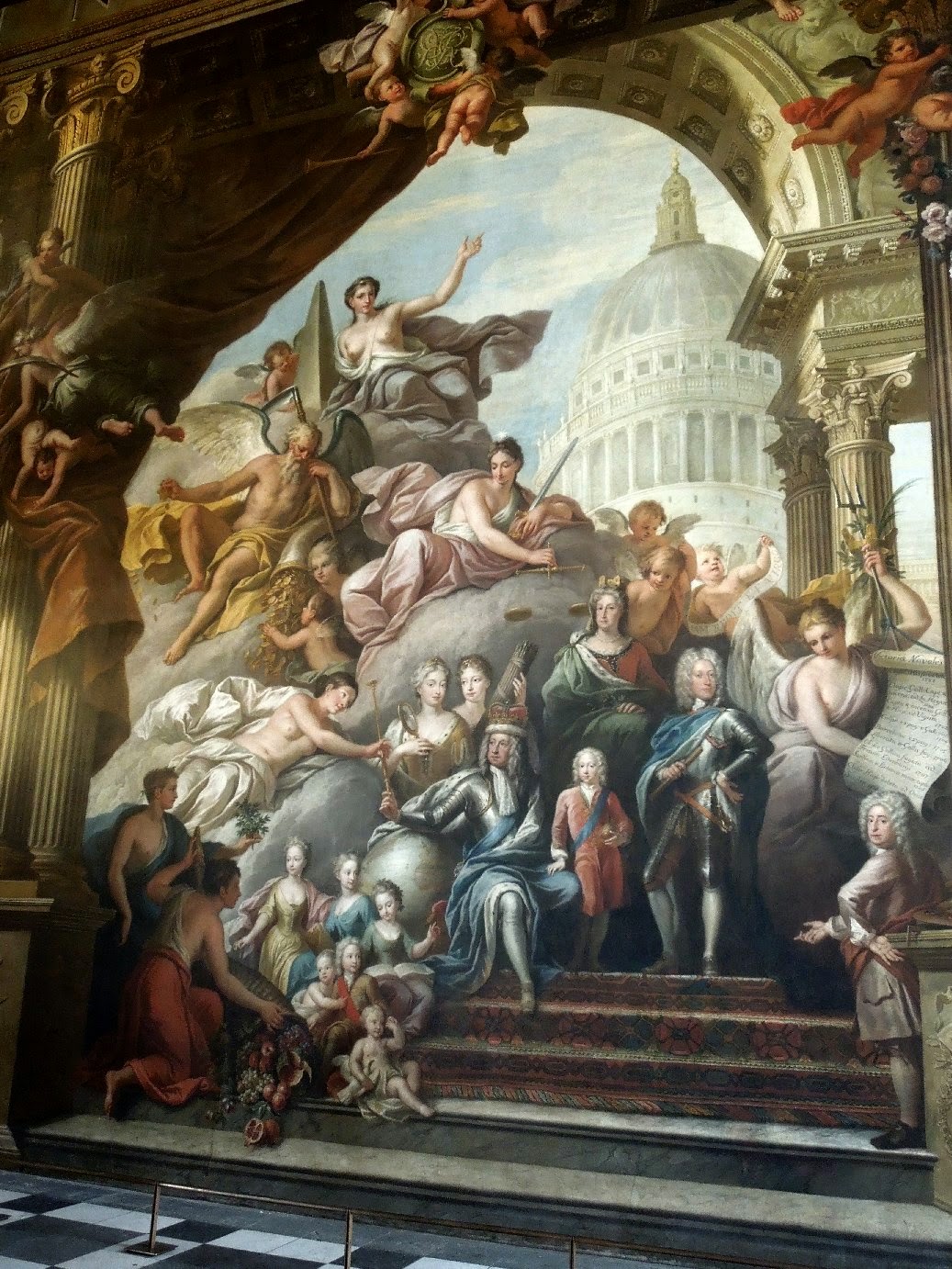
Behind the former hospital is Greenwich Park. The Royal Observatory is located on top of a hill. From the observatory there is an excellent view of Greenwich and beyond.


The Observatory stands on the Prime Meridian which divides the globe into the Eastern and Western Hemispheres. Another visitor was kind enough to take my picture as I straddled the hemispheres (although you can't see my feet which stand on either side of the metal line marking the meridian.) Many years ago on a trip to South America, I stood on the Equator with one foot in the Northern Hemisphere and one foot in the Southern Hemisphere. Now I can say that I have straddled the Eastern and Western Hemispheres as well.

Pictured above is the HMS Belfast, a British cruiser which was active in World War II. It is now a museum ship permanently docked along the Thames. In the background is the skyscraper commonly referred to as The Shard. It was built in 2012, is 72 stories tall, and is the tallest building in the European Union.
Tower Bridge is the best known bridge in London. It was built in the late 1800s. Many people mistakenly think that it is the London Bridge of the nursery rhyme.
Farther down the river are the skyscrapers of Canary Wharf which has become one of the major financial districts of London.
My destination was the end of the line on the "river bus"... Greenwich.
When you get off the boat, the first thing that you see is the famous nineteenth century clipper ship, "Cutty Sark". The ship is in permanent dry dock at Greenwich, and is open to the public.
In the times of the Tudors, Greenwich was the site of the royal Palace of Placentia. It was there that Henry VIII and Elizabeth I were born. By the 1600s the palace was demolished, and King Charles II planned to build a new palace here that would rival the Palace of Versailles in France. Only one section of that palace was completed however. His daughter, Mary II, planned to incorporate that unfinished palace into plans to build a Royal Hospital for Seamen. She commissioned the famous architect Christopher Wren to design the project. It was begun in 1696 but was not completed until 1751. The complex of buildings is one of the greatest works of British architecture.
The Painted Room was designed as the dining hall of the hospital. The walls and ceiling are lavishly decorated with paintings which glorify England's naval power and the triumph of Protestantism under the monarchs William and Mary and Queen Anne. The naval hero Admiral Nelson lay in state here after his death in the Battle of Trafalgar.
Behind the former hospital is Greenwich Park. The Royal Observatory is located on top of a hill. From the observatory there is an excellent view of Greenwich and beyond.
The Observatory stands on the Prime Meridian which divides the globe into the Eastern and Western Hemispheres. Another visitor was kind enough to take my picture as I straddled the hemispheres (although you can't see my feet which stand on either side of the metal line marking the meridian.) Many years ago on a trip to South America, I stood on the Equator with one foot in the Northern Hemisphere and one foot in the Southern Hemisphere. Now I can say that I have straddled the Eastern and Western Hemispheres as well.
Subscribe to:
Posts (Atom)