CDMX

CDMX

Wednesday, December 8, 2021

A Tree of Many Nations

Last weekend, my cousin Gail and her husband Wes invited me to their home for their annual holiday brunch.  (Last year, of course, they did not have it.)  It was, as always, a very pleasant event with delicious food and good company.

Their house is beautifully decorated for the holidays, and I am always drawn to the lovely and unique Christmas tree in the living room.  Gail and Wes are very well-traveled, and she has collected dolls from all the nations they have visited.  She has decorated the tree with the dolls and flags from those countries.  (Forgive me if I am being repetitious. I have probably posted pictures of the tree in years past.)


If you are a long-time reader of my blog, you know that I have been with them on a few of those trips.

Gail and I are related on the Swiss branch of our families.  Her Swiss great-grandfather and my Swiss great-grandmother were brother and sister.  That makes us third cousins.  Gail and Wes have been to Switzerland a couple of times.  On their latest trip there, in August of 2019, they extended their time to meet up with me and to be introduced to our Swiss cousins.  

Several Swiss dolls surround the flag of Switzerland.


Gail and Wes made their first foray into Latin America in January of 2017 when they accompanied me to Mérida, Mexico.  Then in November of 2019 Gail visited me in Mexico City.

I bought the three Mexican dolls on the tree as gifts for Gail.


The doll to the right, in the white dress, is wearing the traditional attire of Yucatán.  Next to her is a doll made out of corn husks.  Below that is a doll from north of Mexico City, made by a woman of the Otomí tribe.

Hopefully, the pandemic will allow them to take more trips soon and to add more dolls and flags to the tree.


Monday, December 6, 2021

A Recipe from Alejandro

Alejandro gave me simple recipe for black bean soup that is very good.  It's his own invention, not a recipe from his mom.

All you need is a can of black beans (I use organic, low sodium beans), a can of chicken broth (also lower sodium broth), a can of diced tomatoes (I buy Mexican-style diced tomatoes with jalapeños, although that made the soup perhaps too spicy for some peoples' tastes), white onion, dried epazote (a Mexican herb which you can probably find at any Hispanic grocery store), salt and olive oil.  Cotija cheese and Mexican crema (or sour cream) are used as a garnish.


(I used for the first time a new blender which I recently bought.  I figured that it was time to retire my mother's Oster blender which had to be more than fifty years old.  By the way, this new Oster blender is made in Mexico... the only one I saw that was not made in China.)


First of all, blend the can of tomatoes (undrained) with one half of the broth and one quarter of the raw onion.


In a large skillet, fry one quarter of an onion in oil until it becomes caramelized.  Then discard the onion.  (Actually, I munched on the onion while continuing the recipe.  It was very tasty.)  Alejandro says that the purpose of this step is to flavor the oil.


Fry the tomato and broth mixture in the hot oil.  Alejandro says to put a couple spoonsful into the skillet first before pouring the rest of the mixture.


In the blender mix the can of beans (drained) and the rest of the chicken broth.


Add that mixture to the skillet and bring it all to a boil.  Season with epazote.  Remove the skillet from the heat, and then add salt to taste.  

Ladle the soup into bowls (it makes 3 to 4 servings), and sprinkle with cotija cheese.  I did not have any sour cream or Mexican crema, but you should put a dollop of that in the middle.


I'm thinking that some tortilla strips, maybe even some slices of avocado, would also make nice garnishes, and would be a fancier presentation if you are inviting guests for dinner.

¡Buen provecho!


Sunday, December 5, 2021

A Walk in the Park and Through the Solar System

You may remember that through the worst of the pandemic I was taking frequent walks through different portions of the Cleveland Metroparks System.  Here in the Greater Cleveland area we are extremely fortunate to have our Metroparks.  It is one of the finest park systems in the country... in fact in 2021 it was once again named the best park in the nation.


Even though it is December, the weather has allowed me to take a couple of long walks in the park this week.  On Wednesday I parked my car along the Valley Parkway and took a six mile round trip walk along one of the park's pedestrian / bicycle paths.  This particular path stretches over twelve miles from Berea following the course of the Rocky River northward almost to the shore of Lake Erie.  I walked from the 12.5 mile marker near the Berea Falls to the 9.5 marker at the Big Cedar Point Picnic Area (which is not to be confused with the famous Cedar Point Amusement Park in Sandusky, Ohio) and back.

Yesterday was a chilly but sunny day, so I took another walk.  This time I parked the car at Big Cedar Point to continue farther along the Valley Parkway's path.


Shale cliffs rise above the Rocky River at Big Cedar Point.  Notice the stairs which climb up the escarpment which is known as Fort Hill.  At the top there are the remains of 2000 year old Native American earthworks.  I have climbed up the stairs a couple of times, although I have not found the earthworks.  I was tempted to go up the 155 steps again, but I decided that I wanted to do another six-mile walk.  Since I started at milepost 9.5, that meant that I would need to continue to milepost 6.5.


The Rocky River just beyond Big Cedar Point


The paved path accommodates walkers and cyclists.

I came to the impressive span of the Brookpark Road Bridge which was built in 1933.


I was a bit shaken when I saw a sign under the bridge warning of falling concrete.  Yes, we really need an infrastructure bill!

Just after milepost 7, I came to the area of the parkway where there are signs with pictures of the planets.  They are positioned at a distance from each other that is proportionate to their distance from the sun in the Solar System.  They obviously revised the signs since scientists decided that Pluto did not deserve the status of a planet.  The first one that I came to was Neptune.


As I continued along my final half mile, I passed Uranus and Saturn.


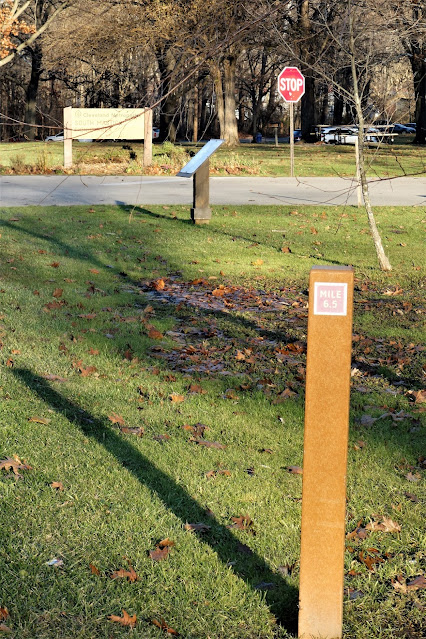
I finally reached my goal... the 6.5 milepost... near the entrance to the South Mastick Picnic Area. 


Just beyond the marker was Jupiter.


I was not going to continue my journey through the Solar System, however.  
It was four o'clock, and I wanted to make the three-mile return hike and get back to my car before sunset.


The December sun had sunk below the tree line by the time I made it back to Big Cedar Point.


Saturday, December 4, 2021

Where Am I Safer?

 Mexico has been devastated by the COVID pandemic.  The official government statistics on cases and deaths are most certainly gross undercounts.  For one thing the testing rate in Mexico has been one of the lowest in the world.  In Mexico there have only been around 91,000 tests given per one million people.  (Compare that to more than 2,000,000 tests per one million people in the U.S.)  Obviously, the more tests that are given, the greater the number of cases that are discovered.  There have also been accusations of undercounting the number of deaths; listing pneumonia as the cause of death when the underlying reason was COVID.  Even though it is only anecdotal evidence, that fact that eleven people on Alejandro's Mexico City street died of the virus is indicative of the gravity of the pandemic.  

Nevertheless, I feel safer down there than I do at home in Ohio.

Whenever I leave my apartment or Alejandro's house, I put on an N-95 mask.  On the streets of Mexico City the majority, maybe two thirds, of the people are wearing masks... even though the risk of contagion is less out of doors.  Yes, there are always some people that I refer to as "screen doors in a submarine" that wear the mask below the nose.  But most people are wearing their facemasks properly.  I am also impressed with the number of people wearing high quality masks such as the N-95 or the KN-95.  You also see people who are wearing both a face mask and a face shield.  

Once you enter any public building you are required to wear a mask.  At many places they also take your temperature as you enter and give you a squirt of hand sanitizer.  (On Mexico City's busy pedestrian Madero Street there are even people... perhaps city employees... that are giving a squirt of sanitizer to any passerby that wants one!)  There are numerous places where you walk over a sanitizing mat upon entering although I personally think that is overkill.  Before entering the National Museum of Anthropology I was even sprayed down front and back with disinfectant!

The weather down there is obviously more conducive to outdoor dining than up here.  Many restaurants have tables outside.  Those that do not will usually have someplace near an open door or large open window where I ask to be seated.  And all of the waitstaff are properly masked.  On all of my trips down there this year, I have only encountered one place, a branch of the taco chain "Taquearte", where some of the waiters had their masks below the nose.  I have not gone to that place since then.

I have even started to use public transportation once in a while in Mexico City.  I avoid hours when the Metrobus or subway cars are crammed like cans of sardines.  Everyone is required to wear a mask, and most everyone is in full compliance.  However, there is the occasional fool who can't take a ride without lowering the mask in order to drink a beverage or eat a snack.  

Upon returning to Ohio, I am shocked when I walk into the supermarket, and I am one of the very few people with a facemask.  (The city of Columbus has a mask mandate, but most of the state, including Cleveland, does not.)  A few weeks before my latest trip, I went out to a restaurant with friends.  The place was packed with people, and not a single waiter or waitress was wearing a mask.  I felt very uncomfortable.

I compare the statistics for Ohio and Mexico.  Even though the Mexican statistics must be taken with much more than a grain of salt, they are going down.  Again, this is anecdotal, but, on my latest trip, Alejandro never mentioned a single friend, acquaintance, or neighbor who had died of COVID.  Here in Ohio, however, the cases are going up.  We are number 7 in population in the U.S., but for the last several days we have been in the top three or four in the number of new cases.  Yesterday we had over 9500 new cases compared to a purported 3088 cases for the entire nation of Mexico.

Yes, in spite of the concern over the Omicron variant, I will happily return to Mexico in January, and take my chances (with proper precautions, of course) down there. 


Friday, December 3, 2021

At the Anthropology Museum Again

More from my October / November trip to Mexico City...

On every trip to Mexico City I make at least one visit to the National Museum of Anthropology.  I already posted an entry and photos about the special exhibit "The Greatness of Mexico".  You may recall that on recent trips I have been going room by room through the recently renovated galleries of the second floor.  While the first floor displays the archaeological treasures of Mexico's pre-Hispanic civilizations, the less visited second floor deals with the indigenous peoples of Mexico today.  

The gallery devoted to the peoples of the Gulf coast is still closed off and under renovation.  The next gallery deals with the Mayas, who constitute the largest native group in present-day Mexico.  I must say that I was somewhat disappointed with the exhibit.  There is a lack of signage describing many of the items in the showcases, so my description here of the gallery is rather sketchy.

The Mayan region covers a geographically diverse area as shown in the mural / map at the entrance to the gallery.


The Mayan realm extends from the scrub forests of the flat Yucatan Peninsula in the north, southward into the dense tropical rainforests and westward into the mountains of the state of Chiapas.  The lives of the various tribes who speak different dialects of Mayan language family are very different.

In Yucatán the Mayan people live in oval huts with a thatched roof.  (If you travel through that part of the country, you will see that in the countryside, a great many still live in these traditional huts.)  The walls are made of poles cut from the forest, covered with a mixture of mud and straw, and then white-washed. 


The inhabitants sleep in hammocks which they unfold and string from the rafters at night.


A beautifully embroidered Mayan dress

Deep in the rainforests near the Guatemalan border are the Lacandon Mayas.  Although they are now adapting modern ways, until well into the 20th century they lived very simple, isolated lives.   They wore tunics made from tree bark, and both men and women had long hair.


They plant small gardens of vegetables, fish, and hunt with bows and arrows.  (I can remember on my first visit to the Mayan ruins of Palenque, some forty years ago, there was a Lacandon man in traditional attire selling bows and arrows to the tourists.)


 In the highlands of Chiapas the people live in stone houses with tile roofs.


The women weave beautiful garments with intricate designs that are identical to the designs seen on ancient Mayan carvings.


The men wear heavy wool ponchos (it gets cold in those mountains!) and hats which are decorated with ribbons.


Pottery from the state of Chiapas.  The clay jaguars from the town of Amatenango have become quite popular in handicraft shops and markets, and I have several at home.


Their religion is an amalgam of Catholicism and traditional Mayan beliefs.


This model of a chapel in Chiapas reminded me of a trip I made some thirty years ago to the town of San Juan Chamula.  Inside the church, which has no chairs, the floor was covered with pine branches, and lit candles were set on the ground.  The villagers were kneeling and chanting in their native Mayan tongue.  It was a very other-worldly experience.


Thursday, December 2, 2021

Back to Jamaica

No, I am not talking about the Caribbean island, but rather the Mexico City market... El Mercado Jamaica.  As you may remember, during my recent trip I visited the Jamaica Market prior to the Day of the Dead.  With more than 1000 flower stands, it is always a fantastic, colorful place.  Before the Day of the Dead it is awash in marigolds as well as decorations for the season.  

Later during my stay, Alejandro and I drove by the market, and I noticed stands along the street that were selling enormous piñatas.  During my last week in Mexico City, I decided to return to see what the market looked like in preparation for Christmas.

From my apartment I walked about twenty-five minutes to the Chilpancingo subway station.  From there it was a straight shot on the metro to the Jamaica station which is located right outside the market.

My first goal was to see those giant piñatas that I had earlier seen from the car.


Many of these piñatas are bigger than I am!

These are the traditional piñatas which feature seven cones representing the seven deadly sins.  The piñatas were introduced by monks as a teaching tool.  If you fight against sin, you are rewarded.  Smash that piñata and you get goodies.  (I didn't actually count the cones on the piñatas, but I think a lot of them had more than seven.  But, then again, most people don't know about its religious origin.  It's just a fun part of Christmas, as well as birthday, celebrations.)

Heading inside the long tent set up along the street, there is a myriad of piñatas.  Besides the traditional ones, nowadays they appear in all sorts of forms.


Ah, but who would want to hit Santa or Rudolph... or even Wonder Woman... with a stick?

I went inside the market building and the piñata wonderland continued.  I was surprised to see them hanging above the produce section.  Alejandro later told me that that is the traditional place for piñatas since originally they were filled with fruit.


Notice the Superman and Star Wars piñatas in the upper right.


The piñatas are an integral part of the "posadas" which are held the nine nights before Christmas.  The neighborhood processions represent Mary and Joseph looking for room at the inn (the word "posada" means "inn"), and they culminate with the breaking of one or more piñatas. Nine nights of "posadas" hosted by millions of Mexico City households... that's a LOT of piñatas!

In this stall you can see how the piñatas are made.  Originally they were made from pottery, but most of them now are papier-mache.  You can see high in the rafters the round balloons that have been covered with papier-mache.  The cones are made with light-weight cardboard and glued onto the globe.  Then the entire piñata is covered with colorful strips of cut tissue paper.


 This fellow was attaching the cones onto a piñata.


Before the Day of the Dead, the stalls along the periphery of the market were filled with Day of the Dead decorations.  Now those stalls were selling Christmas decorations.  Most of the stuff is imported from China.


However, these boxes of "esferas" (Christmas tree balls) were proudly made in Mexico (hecho en México).


These were made in Chignahuapan, a town in the state of Puebla which is known for its Christmas ornaments.

I finally found a section of the market selling what is an essential part of Christmas in Mexico, the "nacimiento" or Nativity scene.  

Some of the figures were very refined, but I am not sure if they were made in Mexico or not.


But these more primitive, clay figurines are very traditional and definitely made in Mexico.


Many Mexican families put up very large, elaborate Nativity scenes that include an entire village full of Mexican people from all walks of life.  And there are animals, and houses, and wells, and bridges crossing rivers, and cactus, and lots and lots of moss to make your landscape look realistic.


It was mid-November, and I was surprised to see stalls outside the market building selling cut Christmas trees.  How are they going to make it through the Day of the Kings on January 6th?


Finally I passed through the enormous section of the Jamaica Market that is devoted to flowers.  The marigolds of the Day of the Dead were long gone, and in their place were "flores de Nochebuena"... Christmas Eve flowers... known to us "gringos" as poinsettias.

The poinsettia originated in Mexico, and got its name from Joel Poinsett, the first U.S. ambassador to Mexico.   He introduced the plant to the U.S. in the 1820s.


A visit to the Jamaica Market this time of year will certainly put you in the Christmas spirit!